Manufacturer may resume shipping HTC One Mini into the UK
HTC UK has released a statement saying it's been granted a stay on the injunction preventing shipments of the HTC One Mini into the UK. This follows a High Court ruling earlier this month which found that a component in the device infringed upon patents owned by Nokia, resulting in an injunction against the handset. At the time any action against the HTC One, which was also found to infringe upon the Finnish manufacturer's patents, was delayed by the judge to give HTC an opportunity to appeal. With today's developments the HTC One Mini now finds itself in a similar situation.
HTC says it'll "continue to aggressively appeal" against the decision on the Nokia patent, while working with suppliers to source alternative parts.
We've got the company's statement in full after the break.
“HTC is delighted that the Court of Appeal has granted a stay on the injunction against our products. We will immediately resume shipment of all of our devices into the UK, including the entire HTC One family. Similarly, our customers should feel confident in their ability to promote and sell all HTC devices. Even though we plan to aggressively appeal the validity decision of Nokia’s EP 0 998 024 patent, we will continue to work with our chip suppliers on alternative solutions to ensure minimal disruption to our business in the future.”
http://www.androidcentral.com
Tampilkan postingan dengan label Patents. Tampilkan semua postingan
Tampilkan postingan dengan label Patents. Tampilkan semua postingan
Apple scores legal victory over Samsung in South Korea
Samsung Electronics Co Ltd on Thursday lost its bid to ban sales of Apple Inc's older iPhone and iPad in South Korea after a court dismissed a lawsuit claiming the U.S. firm had infringed on three of Samsung's mobile patents.
The lawsuit was part of the tech giants' global courtroom battle dating to 2011, when Apple first sued Samsung for copying the look and feel of its iconic iPhone and iPad.
A judge at the Seoul Central District Court said Apple products such as the iPhone 4S, iPhone 5 and iPad2 did not violate Samsung patents on short message display methods and messaging grouping features.
The court ruled against a sale ban on the products and threw out Samsung's claim for 100 million won ($95,100) in damages.
"We are glad the Korean court joined others around the world in standing up for real innovation and rejecting Samsung's ridiculous claims," Apple Korea spokesman Steve Park said.
Samsung said it would thoroughly review the ruling before deciding to whether to appeal.
"As Apple has continued to infringe our patented mobile technologies, we will continue to take the measures necessary to protect our intellectual property rights," Samsung said in a statement.
In a separate ruling in August last year, the same court ordered Apple to pay Samsung 40 million won in damages for infringing two of the South Korean firm's wireless technology patents.
In the same ruling, Samsung was fined 25 million won for violating a patent relating to the so-called bouncing-back function used when scrolling electronic documents.
Thursday's ruling comes after a Mannheim court in Germany dismissed Apple's claim that Samsung infringed on a utility patent that pertains to a multi-language function used in smartphones.
Apple and Samsung have gone to trial twice in the past two years in a San Jose, California federal court, where juries have awarded Apple roughly $930 million in damages.
Shares in Samsung, worth around $221 billion, closed down 0.7 percent on Thursday, versus a 0.5 percent drop in the wider market.
http://www.reuters.com
The lawsuit was part of the tech giants' global courtroom battle dating to 2011, when Apple first sued Samsung for copying the look and feel of its iconic iPhone and iPad.
A judge at the Seoul Central District Court said Apple products such as the iPhone 4S, iPhone 5 and iPad2 did not violate Samsung patents on short message display methods and messaging grouping features.
The court ruled against a sale ban on the products and threw out Samsung's claim for 100 million won ($95,100) in damages.
"We are glad the Korean court joined others around the world in standing up for real innovation and rejecting Samsung's ridiculous claims," Apple Korea spokesman Steve Park said.
Samsung said it would thoroughly review the ruling before deciding to whether to appeal.
"As Apple has continued to infringe our patented mobile technologies, we will continue to take the measures necessary to protect our intellectual property rights," Samsung said in a statement.
In a separate ruling in August last year, the same court ordered Apple to pay Samsung 40 million won in damages for infringing two of the South Korean firm's wireless technology patents.
In the same ruling, Samsung was fined 25 million won for violating a patent relating to the so-called bouncing-back function used when scrolling electronic documents.
Thursday's ruling comes after a Mannheim court in Germany dismissed Apple's claim that Samsung infringed on a utility patent that pertains to a multi-language function used in smartphones.
Apple and Samsung have gone to trial twice in the past two years in a San Jose, California federal court, where juries have awarded Apple roughly $930 million in damages.
Shares in Samsung, worth around $221 billion, closed down 0.7 percent on Thursday, versus a 0.5 percent drop in the wider market.
http://www.reuters.com
Apple put up a claim to Samsung for another $ 22 million
Apple has continued to exhibit new financial claims against the Korean company Samsung. At this time we are talking about the payment of legal costs in the case, which was considered the last 15 months in the court of the city of San Jose, California. As a result of this process has been awarded a penalty in the amount of $ 930 million for copying the iPhone and iPad. Moreover, according to representatives of Apple, the amount of $ 15.7 million will not cover the actual costs and thirds of this process, since the payment of lawyers made more than $ 60 million. Besides compensation to the producer himself has requested $ 6.2 million that was spent on lawyers costs associated with hearings in the case. Overall, in favor of the winner in the dispute must be recovered $ 22 million in legal costs. Hearings on this issue will begin January 30, 2014.
Apple wants Samsung to pay $22M for legal bills
Apple wants Samsung Electronics to pay $22 million of the legal bills that the iPhone and iPad maker has rung up so far defending its mobile device patents in a courtroom battle.
The money sought in documents filed Thursday would be in addition to the $930 million in damages that juries decided Samsung owes Apple Inc. after hearing evidence of patent infringement in two separate trials held in a San Jose, Calif., federal court during the past 15 months. The latest verdict was handed down last month.
Apple is asking U.S. District Judge Lucy Koh to order Samsung to pay $15.7 million in attorney fees. That would cover less than one-third of the more than $60 million that Apple says it owes its lawyers in the case.
Apple also wants Samsung to reimburse its lawyers for $6.2 million in various expenses.
A Jan. 30 hearing has been scheduled to examine Apple's requests.
Lawyers for both Apple and Samsung Electronics Co. figure to make millions of dollars more from the skirmishing between the leading makers of smartphones. Samsung has vowed to appeal the damages that the juries awarded Apple, and another patent infringement trial involving more recent models of the companies' mobile devices is scheduled for next year.
http://m.apnews.com/
The money sought in documents filed Thursday would be in addition to the $930 million in damages that juries decided Samsung owes Apple Inc. after hearing evidence of patent infringement in two separate trials held in a San Jose, Calif., federal court during the past 15 months. The latest verdict was handed down last month.
Apple is asking U.S. District Judge Lucy Koh to order Samsung to pay $15.7 million in attorney fees. That would cover less than one-third of the more than $60 million that Apple says it owes its lawyers in the case.
Apple also wants Samsung to reimburse its lawyers for $6.2 million in various expenses.
A Jan. 30 hearing has been scheduled to examine Apple's requests.
Lawyers for both Apple and Samsung Electronics Co. figure to make millions of dollars more from the skirmishing between the leading makers of smartphones. Samsung has vowed to appeal the damages that the juries awarded Apple, and another patent infringement trial involving more recent models of the companies' mobile devices is scheduled for next year.
http://m.apnews.com/
Apple wants $22 million from Samsung for legal fees
Apple wants $22 million from Samsung for legal fees
http://www.gsmarena.com/apple_wants_22_million_from_samsung_for_legal_fees-news-7328.php
http://www.gsmarena.com/apple_wants_22_million_from_samsung_for_legal_fees-news-7328.php
Samsung Invents Backside Touch Controls for Future Devices with Transparent Displays
Earlier in the quarter the US Patent & Trademark Office published a patent application from Samsung relating to a future transparent display. More specifically, the focus of the invention is on providing a future smartphone with a transparent display that is able to accept touch controls on both the front and back side of the transparent display separately or simultaneously to control actions, move icons, control video playback and more.
Samsung's Patent Background
Next generation display devices including transparent displays have recently been developed. A transparent display has a degree of transparency that enables a viewer to see through the display and view objects behind the display.
A device that includes the transparent display may be any device that that performs operations including recognizing information, processing information, and transferring information. The operations may also be performed by using transparent electronic elements.
The availability of transparent displays has created a need for new and innovative methods of interacting with devices including a transparent display and for expanding the functionality of a user interfaces on devices including the transparent display.
Samsung Invents a Transparent Display and Method for Controlling On Screen Objects
Samsung's invention relates to providing an object control method based on input such as touches on a front side, a rear side, and both sides of a device including a transparent display, the device, and a computer readable recording medium thereof.
Opening App Folders with a Backside Touch
In Samsung's patent FIG. 4 noted below you're able to see an example screen of an object control process. In some ways, the backside touch control process shown in patent FIG. 4 really acts like a zoom in and out feature without obscuring the face screen with your finger. In the example shown, the user is expanding a folder to see the contents using a backside touch. This way the user's finger isn't obscuring their view of the contents of the folder.
http://www.patentbolt.com/2013/12/samsung-invents-backside-touch-controls-for-future-devices-with-transparent-displays.html
Samsung's Patent Background
Next generation display devices including transparent displays have recently been developed. A transparent display has a degree of transparency that enables a viewer to see through the display and view objects behind the display.
A device that includes the transparent display may be any device that that performs operations including recognizing information, processing information, and transferring information. The operations may also be performed by using transparent electronic elements.
The availability of transparent displays has created a need for new and innovative methods of interacting with devices including a transparent display and for expanding the functionality of a user interfaces on devices including the transparent display.
Samsung Invents a Transparent Display and Method for Controlling On Screen Objects
Samsung's invention relates to providing an object control method based on input such as touches on a front side, a rear side, and both sides of a device including a transparent display, the device, and a computer readable recording medium thereof.
Opening App Folders with a Backside Touch
In Samsung's patent FIG. 4 noted below you're able to see an example screen of an object control process. In some ways, the backside touch control process shown in patent FIG. 4 really acts like a zoom in and out feature without obscuring the face screen with your finger. In the example shown, the user is expanding a folder to see the contents using a backside touch. This way the user's finger isn't obscuring their view of the contents of the folder.
http://www.patentbolt.com/2013/12/samsung-invents-backside-touch-controls-for-future-devices-with-transparent-displays.html
Samsung patents backside touch controls for devices with transparent displays
Flexible displays are already a reality on smartphones (even if they aren’t exactly flexible in the real sense), and Samsung is already looking at innovative ways to make use of transparent displays, which are currently in development but will take considerable time to make their way to actual devices. A patent application of Samsung’s describes how touch controls on the back of a device with transparent displays on both sides would allow for different functions to be carried out.
For example, touching the back of the device would let one open a folder from a list of folders, showing a preview of the content residing within the tapped folder; or, a touch on the back would make additional info pop up, such as a note, photo, and more, without having to navigate away from what’s shown on the display on the front. Another nice example described in the patent includes moving two overlapping objects, one with a touch on the face of the device and one with a touch on the back.
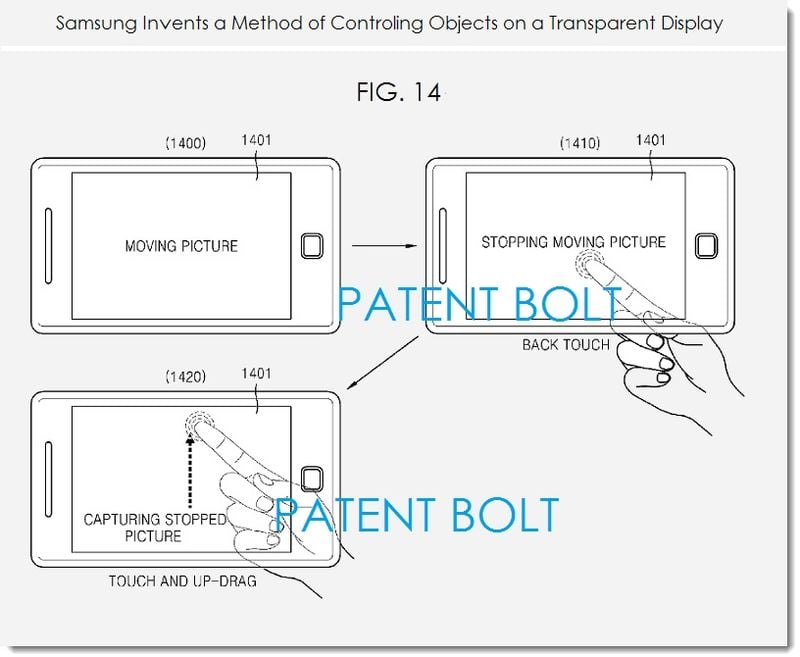
Furthermore, other functions, such as controlling a video or drawing a pattern to unlock the device, are also shown, indicating Samsung has put quite a lot of thought into how transparent displays with backside controls would make the experience a more convenient one. There’s no telling when we’ll see smartphones with transparent displays crop up in the market, but whenever that is, Samsung will likely be a step ahead of other display makers, something that isn’t exactly new for the Korean manufacturer. Hit the source link for more details on the patent.
Samsung Wins Interesting Galaxy Phone & Case Design Patents
Today the US Patent and Trademark Office Granted Samsung a series of 7 new design patents. Within that group were two designs that stood out from the pack. One illustrates an interesting new Galaxy smartphone design and the other a possible eWallet styled cover case accessory.
Unlike "patent applications," design patents published by the U.S. Patent and Trademark Office don't reveal pertinent information about a particular design. We can look at the design and appreciate it for what it projects, but we'll never discover which materials may be used to construct the design. We'll never know what unique internal components may be hidden within the device or learn about any unique features that we could look forward to. All we get is the simple visual of what could be coming down the pipeline.
Samsung Wins New Galaxy Phone Design
Samsung was granted a new design patent today which was originally filed for in April 2013 in the US and in October 2012 in Korea. The new design tries to provide the image of a thinner form factor on certain angles as noted below. The design offers a slightly different camera set up on the backside and has no ports on the top of the unit.
http://www.patentbolt.com/2013/12/samsung-wins-interesting-galaxy-phone-case-design-patents.html
Unlike "patent applications," design patents published by the U.S. Patent and Trademark Office don't reveal pertinent information about a particular design. We can look at the design and appreciate it for what it projects, but we'll never discover which materials may be used to construct the design. We'll never know what unique internal components may be hidden within the device or learn about any unique features that we could look forward to. All we get is the simple visual of what could be coming down the pipeline.
Samsung Wins New Galaxy Phone Design
Samsung was granted a new design patent today which was originally filed for in April 2013 in the US and in October 2012 in Korea. The new design tries to provide the image of a thinner form factor on certain angles as noted below. The design offers a slightly different camera set up on the backside and has no ports on the top of the unit.
http://www.patentbolt.com/2013/12/samsung-wins-interesting-galaxy-phone-case-design-patents.html
Samsung granted patents on new phone and phone case design. Could the former be for the Galaxy S5?
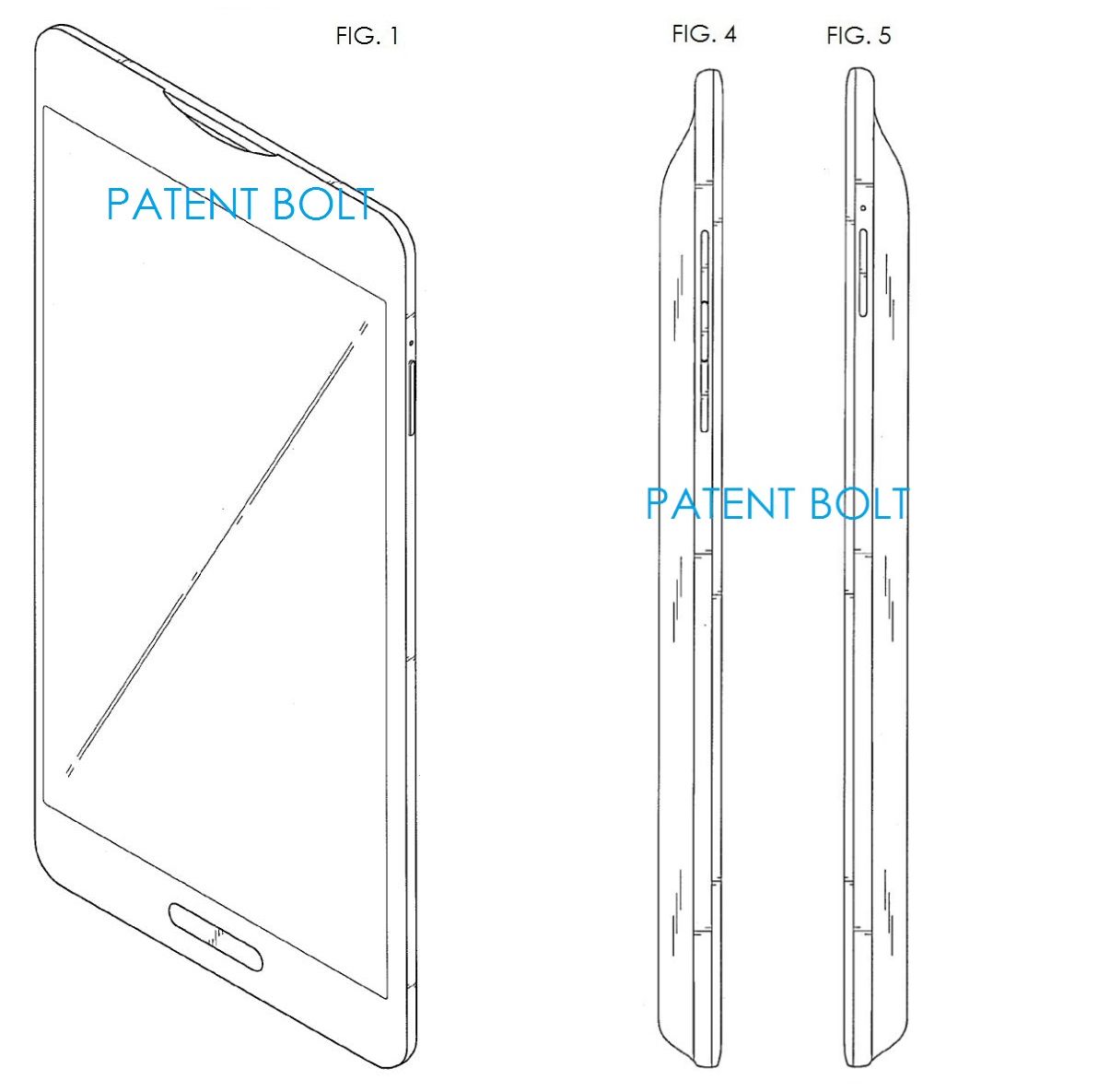
Samsung was recently granted a couple of design patents by the US Patent and Trademark Office, and two of them reveal possible upcoming designs for the company’s phones and also cases for those phones. The new phone design shows a device that’s similar to the Galaxy Note 3 in that it sports rather square edges with just a hint of roundness. The back is a bit different that you see on the Galaxy S4, and all the ports, like the USB and headphone jack, are placed at the bottom – the back also juts out quite a bit, but if the design does make it to a phone in the future (maybe the Galaxy S5?), the final product will likely be as thin and proportional as current Samsung handsets.
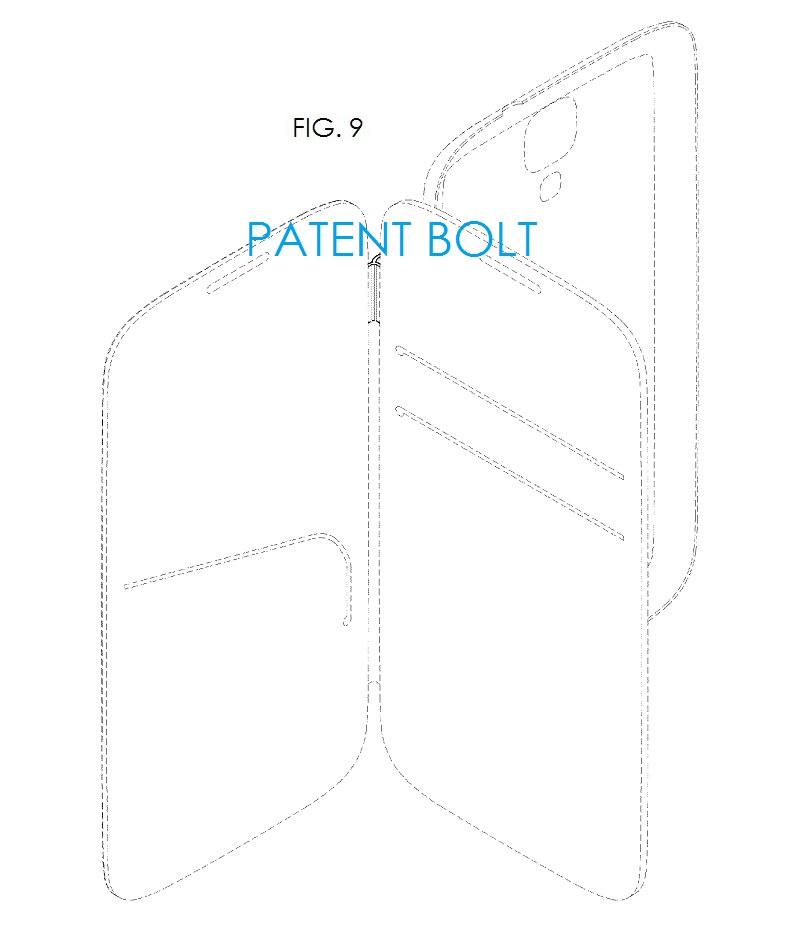
Meanwhile, the phone case design patent shows an evolution of the wallet-like cases Samsung already makes for its devices. There are the usual two front and back flaps, but a third flap in between the two looks designed to hold things such as credit and debit cards. Since these design patents have actually been granted, there’s a high chance we’ll see Samsung use either on future devices, though it could be rather long time before that happens.
Head to the source link to get more details and pictures on the phone and phone case patents.
HTC One ban looms as Nokia wins latest patent dispute
Nokia is one step closer to a ban on the HTC One and all HTC's Android smart phones after another legal victory in the British courts.
Foss Patents reports that Justice Arnold of the England and Wales High Court ordered an injunction against HTC in a battle over patent, but did give HTC the chance to appeal on limited grounds. The injunction has been delayed until Friday, the deadline for HTC to apply for a wider-ranging appeal.
Nokia won the first round of the legal scrap in October, with similar cases going on in six countries around the world. Nokia has called for a ban on HTC phones and financial compensation for each phone sold. As a ban looms, HTC is likely, however, to pony up some cash and settle with Nokia -- yet another financial blow for the struggling Taiwanese company.
"HTC is pleased by the decision of the High Court of England and Wales to stay an injunction against certain chipsets, including those in our flagship HTC One," says HTC, "pending the outcome of our appeal against the validity and infringement of Nokia's EP 0 998 024 patent. Whilst the Court also granted an injunction that affects other third party chipsets, we have filed urgent application to appeal. In the meantime, we are working with our chip suppliers to explore alternative solutions . As always, HTC's primary focus is on supporting our customers and ensuring minimal disruption to them and our business. Rest assured that our award winning HTC One handset will be available as usual."
The contested patent is EP0998024 on a "modular structure for a transmitter and a mobile station", which relates to the modulator technology in phones that transmits data. HTC argues the kit in question is part of the Qualcomm chips installed in its phones, and as such should be covered by a deal between Qualcomm and Nokia in the US.
“Potentially this is a further blow to HTC given the challenging year it has already had," says industry expert Ben Wood of CCS Insight. "But right now this will have little impact as any injunction is delayed pending appeal. Both sides will doubtless continue the legal fight, as these sorts of battles characterise the mobile device landscape more and more.”
As part of its evidence, HTC has also thrown rivals under the bus, claiming that Apple, BlackBerry, Google, LG, Samsung and Sony also sell phones -- or, in Sony's case, a tablet -- with chips that also infringe the patent.
http://crave.cnet.co.uk/
Foss Patents reports that Justice Arnold of the England and Wales High Court ordered an injunction against HTC in a battle over patent, but did give HTC the chance to appeal on limited grounds. The injunction has been delayed until Friday, the deadline for HTC to apply for a wider-ranging appeal.
Nokia won the first round of the legal scrap in October, with similar cases going on in six countries around the world. Nokia has called for a ban on HTC phones and financial compensation for each phone sold. As a ban looms, HTC is likely, however, to pony up some cash and settle with Nokia -- yet another financial blow for the struggling Taiwanese company.
"HTC is pleased by the decision of the High Court of England and Wales to stay an injunction against certain chipsets, including those in our flagship HTC One," says HTC, "pending the outcome of our appeal against the validity and infringement of Nokia's EP 0 998 024 patent. Whilst the Court also granted an injunction that affects other third party chipsets, we have filed urgent application to appeal. In the meantime, we are working with our chip suppliers to explore alternative solutions . As always, HTC's primary focus is on supporting our customers and ensuring minimal disruption to them and our business. Rest assured that our award winning HTC One handset will be available as usual."
The contested patent is EP0998024 on a "modular structure for a transmitter and a mobile station", which relates to the modulator technology in phones that transmits data. HTC argues the kit in question is part of the Qualcomm chips installed in its phones, and as such should be covered by a deal between Qualcomm and Nokia in the US.
“Potentially this is a further blow to HTC given the challenging year it has already had," says industry expert Ben Wood of CCS Insight. "But right now this will have little impact as any injunction is delayed pending appeal. Both sides will doubtless continue the legal fight, as these sorts of battles characterise the mobile device landscape more and more.”
As part of its evidence, HTC has also thrown rivals under the bus, claiming that Apple, BlackBerry, Google, LG, Samsung and Sony also sell phones -- or, in Sony's case, a tablet -- with chips that also infringe the patent.
http://crave.cnet.co.uk/
Nokia wins UK injunction against HTC devices including the One mini -- HTC can appeal
Settlement pressure on HTC is increasing significantly after Justice Arnold of the England and Wales High Court ordered an injunction against various HTC devices based on EP0998024 on a "modular structure for a transmitter and a mobile station", a mobile phone hardware patent that he found valid and infringed by HTC'various HTC products including its current Android-based flagship, the HTC One, in an October 30 ruling.
The injunction is "final" as far as the High Court is concerned, but Justice Arnold granted HTC permission to appeal ("albeit on more limited grounds than HTC had sought permission in respect of") and a stay of the injunction "pending the judgment of the Court of Appeal". HTC has until 4 pm UK time on December 6 to apply to the Court of Appeal for permission to appeal against Justice Arnold's "refusal of a wider stay".
Nokia is asserting this patent against HTC in several countries and issued the following statement on the decision:
"Nokia is pleased that the UK High Court has imposed an injunction on certain HTC products found in October to infringe a Nokia patent. The injunction is stayed until December 6 to allow HTC time to appeal. Pending the appeal, HTC has undertaken not to ship any more of the infringing products into the UK, except the HTC One which it may continue to sell until the conclusion of any appeal. If HTC does not succeed on appeal, the injunction will take effect on all infringing products. Nokia is also claiming financial compensation for the infringement of this patent."
Nokia just received good news yesterday in the United States, where Microsoft's acquisition of Nokia's wireless devices business received fast-track clearance from antitrust regulators. I understand that the European Commission's Phase 1 review will also conclude this week, and I would be very surprised if this procompetitive transaction wasn't also cleared immediately in the EU -- the only logical outcome unless antitrust law is suddenly turned on its head.
Patent licensing will be a substantial part of Nokia's revenue opportunity after the closing of the Microsoft deal, and the dispute with HTC is an important one because Nokia faces an unwilling licensee of its non-standard-essential patents. It's SEPs are already broadly licensed. Its non-SEPs are not, so there is potential upside for investors in that regard. From an enforcement point of view both categories of patents present different challenges. HTC will only take a royalty-bearing license from Nokia at a point at which the latter has substantial leverage. Otherwise HTC will continue to defend itself in court.
Nokia is suing HTC in six countries on three continents (US, UK, Germany, Netherlands, Italy, Japan) and gaining more and more leverage, which is why we may see a settlement even before the end of the year. In the United States, Nokia won a preliminary ruling at the ITC over two patents, and the result could be a U.S. import ban against HTC's Android-based devices. Some organizations have raised public interest concerns in that regard, but if the ITC upholds the liability findings, an import ban is going to be almost inevitable. And on Friday (December 6), the Munich I Regional Court will announce a ruling on a German Nokia v. HTC case over a USB-related patent (not a SEP, but it appears rather powerful). At the September trial Nokia appeared to be on the winning track. I will also attend the Friday announcement.
The decision mentions that, according to evidence adduced by HTC, various other companies (Apple, BlackBerry, Google/LG, Samsung and Sony) "are also marketing phones (or, in Sony's case, a tablet) containing infringing chips in the UK".
Finally, here's today's order:
http://www.fosspatents.com/2013/12/nokia-wins-uk-injunction-against-htcs.html
The injunction is "final" as far as the High Court is concerned, but Justice Arnold granted HTC permission to appeal ("albeit on more limited grounds than HTC had sought permission in respect of") and a stay of the injunction "pending the judgment of the Court of Appeal". HTC has until 4 pm UK time on December 6 to apply to the Court of Appeal for permission to appeal against Justice Arnold's "refusal of a wider stay".
Nokia is asserting this patent against HTC in several countries and issued the following statement on the decision:
"Nokia is pleased that the UK High Court has imposed an injunction on certain HTC products found in October to infringe a Nokia patent. The injunction is stayed until December 6 to allow HTC time to appeal. Pending the appeal, HTC has undertaken not to ship any more of the infringing products into the UK, except the HTC One which it may continue to sell until the conclusion of any appeal. If HTC does not succeed on appeal, the injunction will take effect on all infringing products. Nokia is also claiming financial compensation for the infringement of this patent."
Nokia just received good news yesterday in the United States, where Microsoft's acquisition of Nokia's wireless devices business received fast-track clearance from antitrust regulators. I understand that the European Commission's Phase 1 review will also conclude this week, and I would be very surprised if this procompetitive transaction wasn't also cleared immediately in the EU -- the only logical outcome unless antitrust law is suddenly turned on its head.
Patent licensing will be a substantial part of Nokia's revenue opportunity after the closing of the Microsoft deal, and the dispute with HTC is an important one because Nokia faces an unwilling licensee of its non-standard-essential patents. It's SEPs are already broadly licensed. Its non-SEPs are not, so there is potential upside for investors in that regard. From an enforcement point of view both categories of patents present different challenges. HTC will only take a royalty-bearing license from Nokia at a point at which the latter has substantial leverage. Otherwise HTC will continue to defend itself in court.
Nokia is suing HTC in six countries on three continents (US, UK, Germany, Netherlands, Italy, Japan) and gaining more and more leverage, which is why we may see a settlement even before the end of the year. In the United States, Nokia won a preliminary ruling at the ITC over two patents, and the result could be a U.S. import ban against HTC's Android-based devices. Some organizations have raised public interest concerns in that regard, but if the ITC upholds the liability findings, an import ban is going to be almost inevitable. And on Friday (December 6), the Munich I Regional Court will announce a ruling on a German Nokia v. HTC case over a USB-related patent (not a SEP, but it appears rather powerful). At the September trial Nokia appeared to be on the winning track. I will also attend the Friday announcement.
The decision mentions that, according to evidence adduced by HTC, various other companies (Apple, BlackBerry, Google/LG, Samsung and Sony) "are also marketing phones (or, in Sony's case, a tablet) containing infringing chips in the UK".
Finally, here's today's order:
http://www.fosspatents.com/2013/12/nokia-wins-uk-injunction-against-htcs.html
Glimpse of TouchWiz 'future (on the Galaxy S5?) Interface adapts to your hand
There's been a lot of discussion about what off-screen on a smartphone is ideal. Growing monitors allow you to browse, although becoming finer and videos and pictures look, but many people can have their t oxygen apparatus, let alone a Samsung Galaxy Note 3 , do not operate it with one hand.Now that's not a problem, but for example, offers Samsung Galaxy Note 3 precisely those countless options to make. single-handed operation as possible And if we have a recently published patent - with the somewhat boring entitled Method and Apparatus or Controlling User Interface Using Touch Screen - may believe there will be more opportunities for one-handed operation. The key question then naturally arises in our mind is equal or this might be a new feature of - yes - the Samsung Galaxy S5 .
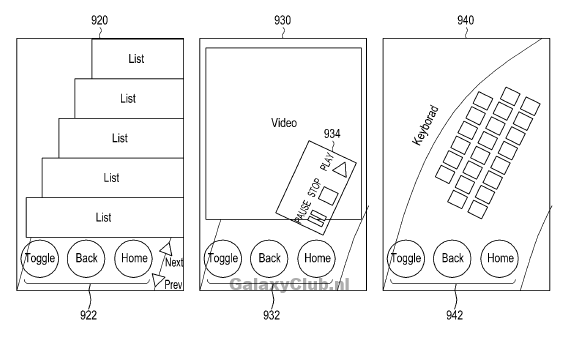
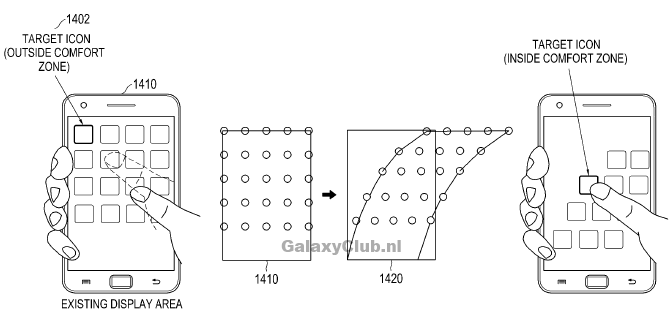
This patent - unearthed from the basement of the World Intellectual Property Organization , or WIPO - was filed on May 21, but only 28 published last November. It is quite a technical treatise, but the patent describes - features pictures! - A method to adjust to a graphical interface to the comfort zone of the user.

The comfort zone is defined by the scope of the thumb. By switching on the control option described kinds of controls can be placed so that they are also a relatively large screen accessible - continue - and operable. We see how Samsung among others want to change. Displaying lists, the video or the keyboard

It is also possible the "density" of the different elements - depending on personal preference Be it suppleness of your thumb to change -. Icons, for example,


The major advantage of the method shown is of course that you as a user no longer attached to the standard pattern, which controls neatly over the screen, whether or not in a grid, are divided. It might take some getting used, but the hitherto used method for one-handed operation, such as the Galaxy Note 3, is - let's say - rather suboptimal.
Whether the new method works for pleasant, of course we can only say if we tried this in practice - ie: not yet. Samsung Knowing this first option that you can put out. To taste or This is also evident from the patent itself, which also seems to have been given the option to have multiple comfort zones to set. But the promise of such, customizable interface is of course great: a smartphone remains comfortable to use, despite the big screen with one hand. But thanks to the big screen, you can enjoy all the benefits like nice browsing, watching video, or admire your own or other people's photos.
It remains to mention that the course is never sure when or if we like, patented feature actually see popping up. A new device It seems at least a typical feature of a new version of Samsung's TouchWiz interface - and new TouchWiz versions always come to a new Galaxy S flagship. On the not-so-long run, this would therefore be the Galaxy S5. But indeed, it is and remains speculation.
The patent in question can be found at the WIPO, HERE .

Patent shows possible Galaxy S5 feature: improved one-hand operation with custom orientation of on-screen apps
One-hand operation of smartphones is becoming more and more of an inconvenience as display sizes become bigger with each passing year. Samsung mitigates the issue by offering a one-handed operation mode on the Galaxy Note 3, which reduces the size of the on-screen content and pushes it to a particular side of the screen, and the Korean company might be working on making one-hand operation even better with the Galaxy S5.
A patent application describes a feature that will let a user resize the on-screen interface according to his/her comfort zone., described by the scope of the thumb. Furthermore, instead of a standard square window and portrait/landscape orientation, a particular app’s window would be resizable to any odd form and placed on a particular side of the screen, rotated diagonally and/or any which way the user would want; users will also be able to change the density of the interface’s elements, such as the on-screen icons. It’s an interesting feature, and one that would make the one-hand experience on the Galaxy S5 even better, especially if Samsung intends to adopt a larger screen than the one on the S4′s.
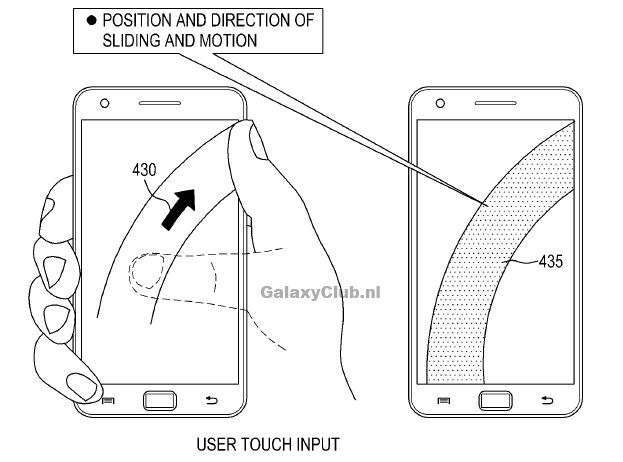
As always, a patent application doesn’t mean we’ll see the feature actually be used any time soon (if at all), but in this case, it would be a nice feature to flaunt for the Galaxy S5, and it will likely make its way to older smartphones like the Galaxy Note 3 (which would benefit greatly from it). The source link has more details on how the feature would work, so go ahead and give it a good read.
Jury awards $290 million towards damages to Apple in case retrial
The jury has given their verdict in the partial retrial of the Apple vs Samsung case. After being awarded a hefty sum of $1.05 billion in damages to Apple, judge Lucy Koh reduced the damages by $450.5 million as she considered the number to be based on some wrong calculation.
The new jury has now ruled that Samsung needs to pay a sum of $290 million, in addition to $598 million from the first case, taking the total to $888 million.
It goes without saying that Samsung will contest the damages further in appeals and post-trial motion, so we’ll have to wait for the word from the judge for the final figure.
Samsung to pay Apple additional $290 million
Samsung to pay Apple additional $290 million
http://www.gsmarena.com/samsung_to_pay_apple_additional_290_million_-news-7234.php
http://www.gsmarena.com/samsung_to_pay_apple_additional_290_million_-news-7234.php
Jury awarded another 290 million payments in favor of Samsung Apple
The battle between Apple and Samsung in a U.S. court continues. Earlier, the jury has reached a verdict that Samsung is obliged to pay more than a billion dollars in fines to Apple for patent infringement. Later, the amount has been revised and updated payments had to make 599 million. Now, however, another jury sentenced Samsung to pay another $ 290 million, bringing the total amount again to the billionth mark. Meanwhile, Apple representatives believed that the penalty should reach $ 380 million, while the Samsung averaged only $ 52 million. That is, in general, this figure is much closer to the position of the American company, rather than Korean. Both companies have already voiced their attitude to the verdict, and there are no surprises. Samsung representatives were disappointed with the court's decision and will continue to appeal, applying for a retrial, payout. Cause of the defeat, the company considers the imperfection U.S. patent law. In Apple also expressed their full satisfaction, stressing that the company does not protect its financial resources or patents, and the possibility of creating unique innovations. Same penalty is seen as the price that Samsung has to pay for copying.
Samsung Patent Filing for Retina Scanner Supports Rumors
Earlier in the quarter the US Patent & Trademark Office published a patent application from Samsung that relates to a possible future authentication system for devices like their Galaxy line of smartphones and tablets. The patent supports the rumors that began to surface in mid-October.
Samsung's Patent Background on Authentication Technology
Iris scanning is used to collect information of characteristics of respective attributes of irises of people and use the information in authentication technology for security. The iris has unique patterns whose number is larger than that of the fingerprint. Further, iris scanning is a non-contact type of scanning and authentication, and thus people do not feel uncomfortable with the iris scanning. In addition, a person may be accurately identified even if the person wears eyeglasses or contact lenses. Moreover, iris scanning usually takes less than two seconds, and thus iris scanning is being evaluated as a biometric identification technology more advanced than a fingerprint or retina scanning technology.
Further, as a terminal, such as a portable terminal, a mobile device, a cell phone, or other electronic devices, gets rapidly sophisticated, the amount of information stored in the terminal increases, the importance of information is on the increase, and a security technology applied to the terminal is also getting sophisticated. As described above, iris scanning is a technology more advanced than a fingerprint or retina scanning technology in terms of the accuracy and speed, and scanning without contact is possible using a camera. Hence, if iris scanning is applied to the terminal, the security of the terminal may be more strengthened, and the terminal may provide various services related with authentication to user.
However, despite all such advantages, iris scanning is not being widely applied to terminals in Korea and elsewhere. This is partly because of the costs of iris scanning technology in the prior art, but is also because of the scanning rate problem. In the case of the prior art which applies iris scanning, a terminal uses a flash built in for photographing as illumination for iris scanning. In the case of some people, such as non-Asians, iris scanning is possible only using a general flash as illumination. However, in the case of other people, including Asian people, many Asians do not have sufficient melanin pigments in their eyes, and thus infrared rays need to be stably secured. As a result, an illuminator of infrared rays needs to be separately installed to increase the iris scanning rate. However, having a separate built-in infrared ray illumination for iris scanning would make it difficult for the terminal to be lighter and smaller.
http://www.patentbolt.com/2013/11/samsung-patent-filing-for-retina-scanner-supports-rumors.html
Samsung's Patent Background on Authentication Technology
Iris scanning is used to collect information of characteristics of respective attributes of irises of people and use the information in authentication technology for security. The iris has unique patterns whose number is larger than that of the fingerprint. Further, iris scanning is a non-contact type of scanning and authentication, and thus people do not feel uncomfortable with the iris scanning. In addition, a person may be accurately identified even if the person wears eyeglasses or contact lenses. Moreover, iris scanning usually takes less than two seconds, and thus iris scanning is being evaluated as a biometric identification technology more advanced than a fingerprint or retina scanning technology.
Further, as a terminal, such as a portable terminal, a mobile device, a cell phone, or other electronic devices, gets rapidly sophisticated, the amount of information stored in the terminal increases, the importance of information is on the increase, and a security technology applied to the terminal is also getting sophisticated. As described above, iris scanning is a technology more advanced than a fingerprint or retina scanning technology in terms of the accuracy and speed, and scanning without contact is possible using a camera. Hence, if iris scanning is applied to the terminal, the security of the terminal may be more strengthened, and the terminal may provide various services related with authentication to user.
However, despite all such advantages, iris scanning is not being widely applied to terminals in Korea and elsewhere. This is partly because of the costs of iris scanning technology in the prior art, but is also because of the scanning rate problem. In the case of the prior art which applies iris scanning, a terminal uses a flash built in for photographing as illumination for iris scanning. In the case of some people, such as non-Asians, iris scanning is possible only using a general flash as illumination. However, in the case of other people, including Asian people, many Asians do not have sufficient melanin pigments in their eyes, and thus infrared rays need to be stably secured. As a result, an illuminator of infrared rays needs to be separately installed to increase the iris scanning rate. However, having a separate built-in infrared ray illumination for iris scanning would make it difficult for the terminal to be lighter and smaller.
http://www.patentbolt.com/2013/11/samsung-patent-filing-for-retina-scanner-supports-rumors.html
Samsung’s patent application supports rumors of Galaxy S5 sporting eye-scanning technology
Back in October, when the rumor mill was only just kicking off its endeavor to offer us speculation on the Galaxy S5, a rumor cropped up suggesting that Samsung’s next flagshipmight feature eye-scanning technology instead of a fingerprint sensor. At the time, we didn’t give much thought to this rumor, but a patent application discovered by folks over at Patent Bolt suggests that early rumor might just turn into reality when the S5.
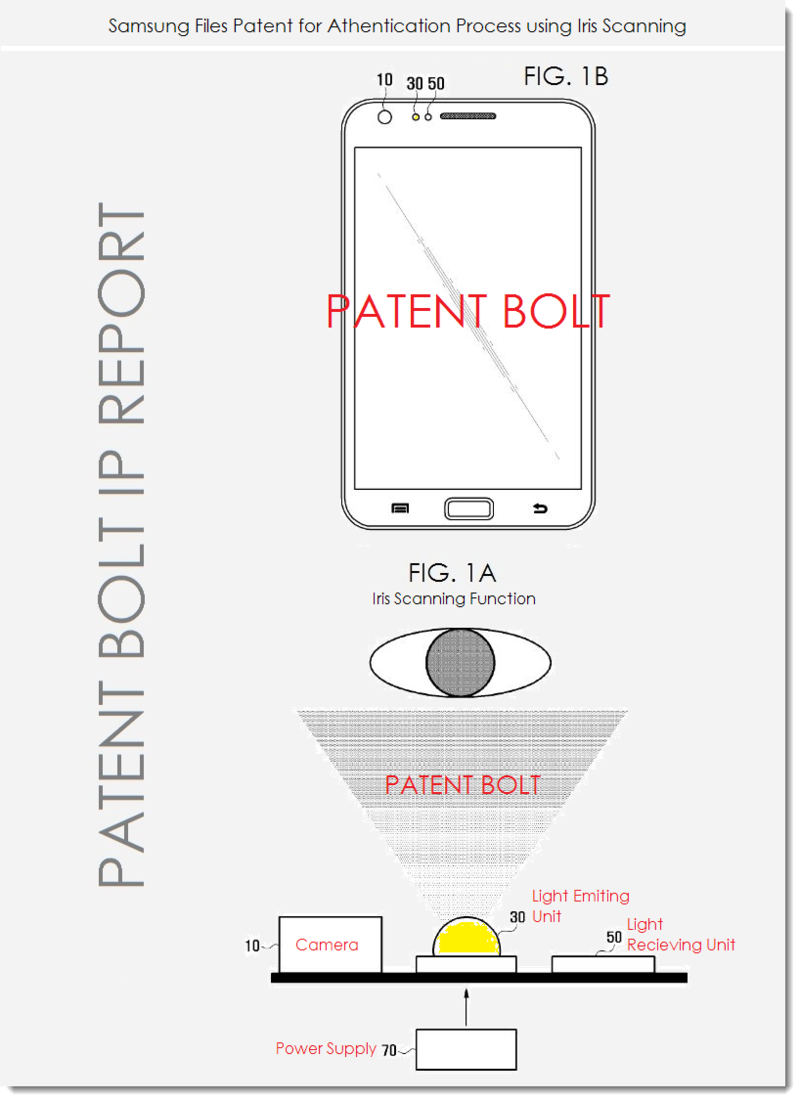
Samsung’s eye scanner will use the technique of iris scanning. Standard iris scanning techniques offer advantages such as quicker detection than retina or fingerprint scanners but are rather costly, so Samsung will be using its own implementation to reduce costs. The patent figures show a smartphone with the necessary apparatus inside, (camera, a proximity sensor, and light emitting, light receiving and power supply units) – the proximity sensor will sense when an object has approached the camera, and an iris sensing unit will then scan the iris and match it with the iris info of a user that’s stored on the device.
It’s all a bit technical, with more details available at the via link, but for now, it seems that even if Samsung’s eye-scanning tech isn’t ready in time for the Galaxy S5, it will certainly make an appearance on one of Samsung future flagships – maybe on the Galaxy Note 4 or the rumored Galaxy F series of super premium smartphones?
Apple gets another chance to ban Samsung products in the US
Ready for another bout between Apple and Samsung? The latest development comes from the United States Court of Appeals for the Federal Circuit where the court affirms injunction denial for design patents but Apple can try again with the technical utility patents. Last time Apple had to prove the patented feature as the “sole” reason for driving sales of the products but this time Apple will have to show “some connection between the patented feature and demand for Samsung’s products”.
If the evidence proves “the inclusion of a patented features makes a product significantly more desirable”, the injunction could be very well on the cards against Samsung products.
You can read the detailed appeal document at the source link below.
Samsung working on portable fitness accessory called the Samsung Sport
The Galaxy S4 was the first Samsung device that had a focus on health-related features, and the Galaxy Gear also comes with a pedometer to help users track various physical parameters. It was rumored that the company isworking on numerous wearable devices, and it looks like a portable fitness accessory could be one of them – Samsung has applied to the USPTO to trademark the brand name Samsung Sport, and the description mentions functionality such as monitoring parameters such as heart rate, blood pressure, steps taken, the amount of calories burned, and more.
The Samsung Sport will also be able to measure, collect, and track data about sleep patterns, similar to Nike’s FuelBand SE, a popular fitness accessory for iOS that Samsung’s Sport will go up against, but hopefully with the option to pair with many more devices than is possible with the FuelBand. As always, a trademark application doesn’t necessarily mean we’ll see an actual product, but for those fitness freaks out there, the Samsung Sport might be something to look out for.

Langganan:
Postingan (Atom)